
You take off your socks in the evening and they have left a pink mark on your calf, like an elastic band. Your ankles have vanished. Your legs feel heavy, as if you had been carrying water in them all day.
I know those legs. I see them on my table every day. And let me tell you something right away that will take half the stress off your mind: in most cases, swollen legs are not a disease. It is fluid pooling. Water that got stuck because it had no way to drain. But sometimes the swelling is a signal you must not ignore, and that is what I want to teach you most today. I will show you how to tell the two apart and when lymphatic drainage will truly help, and when it will only be a pleasant expense with no effect.
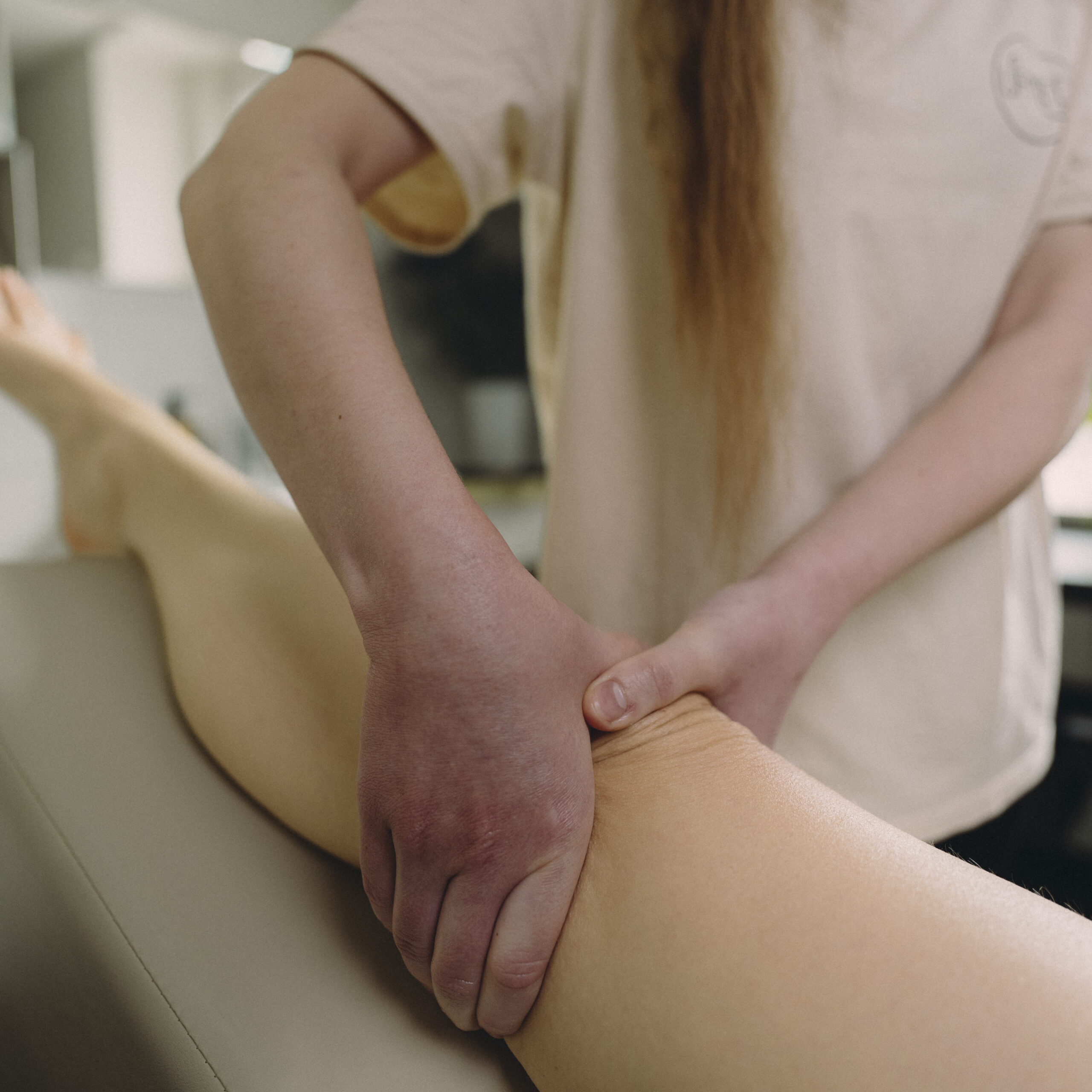
Price: from 210 to 360 PLN
Location: Warsaw, Powiśle (Dobra Street)
Where leg swelling comes from (and why it is usually not your fault)
Your blood has a heart, a pump. Your lymph has nothing. It flows only when you move your muscles. Imagine a river that flows only because someone is paddling it. You stop paddling, the river stops, and the water spills wherever it is lowest. On you, the lowest point is your ankles.
That is why your legs swell most often when:
- you sit at a desk for eight hours or stand all day behind a counter or in a treatment room,
- it is hot and your blood vessels dilate,
- you are in the second half of your cycle or pregnant, and hormones hold on to water,
- you have eaten something very salty (salt pulls water like a magnet),
- you take certain medications, for example for blood pressure or hormonal ones.
This kind of swelling is usually symmetrical (both legs swell about the same), it appears in the evening and it is gone by morning. This is the most common scenario I see. And this is exactly what I have the best tools for.
Swollen legs after work versus swelling that should worry you
Let me teach you a simple test. Sit down and check for yourself:
- Do both legs swell about the same and look fine in the morning? That is simple fluid pooling. Relax.
- Has one leg swollen up, does it feel warmer, is it red and painful? I do not touch that one on my own. First we go to a doctor to rule out dangerous causes. But that does not mean there is no work for me here: one-sided swelling often has a lymphatic background, and then I do work on it, only in close cooperation with a doctor.
It sounds trivial, but this difference can save your health. So let us go on, because it matters.
When leg swelling is a signal to see a doctor first, not me
There are days when I send a client straight from my table to a doctor. And I do it without hesitation. Do the same if:
- one leg has suddenly swollen, is warm, red and painful (this can look like thrombosis, and with thrombosis drainage does not help, it harms),
- the swelling grows from day to day and does not go down overnight,
- it comes with shortness of breath, chest pain, or you notice you are passing less urine,
- the leg swelled after a cut or a bite and the skin turns hot,
- you have a heart, kidney, liver or thyroid condition and the swelling is getting worse.
I am not trying to scare you. It is simply that no massage can heal a sick heart or kidneys, and trying to massage away thrombosis is playing with fire. That is why, before I even touch you, I ask and I listen. It is not a formality, it is safety.
Lymphatic drainage for swollen legs: what actually happens on my table
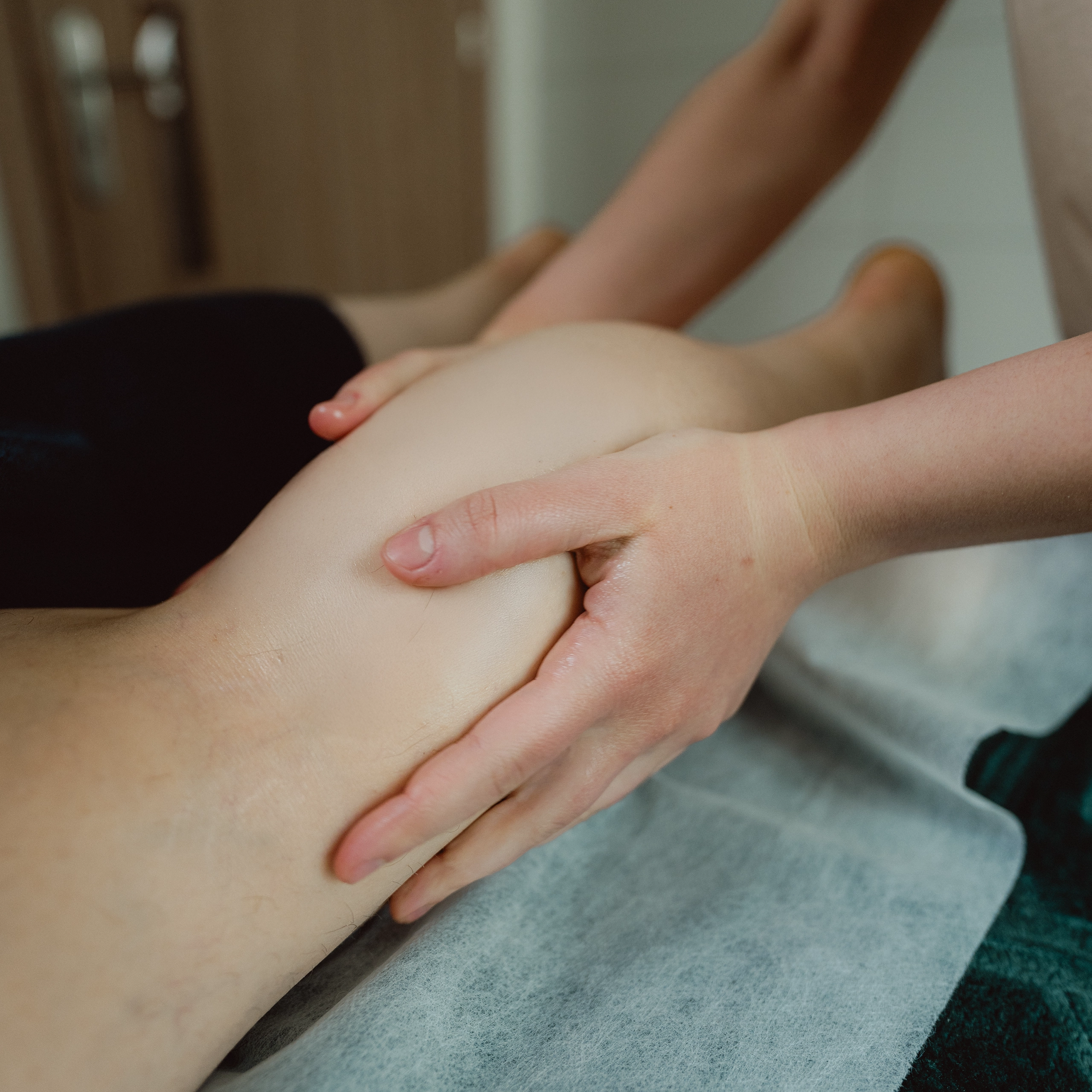
Forget hard kneading. Drainage is the opposite. It is a slow, rhythmic movement of fluid toward the lymph nodes, as if I were opening a dam and showing the water which way to flow. Gently, because these lymphatic channels lie just under the skin and too much pressure simply pinches them shut. You press down on a garden hose and then wonder why nothing comes out.
What you feel when you get off the table with simple fluid pooling:
- your legs are noticeably lighter and your ankles come back to their place, often right away,
- that tight, bursting feeling is gone,
- after a series of treatments the effect is easier to keep, because your lymph gets going and starts working better on its own.
And here is something no one tells you honestly: what drainage will not do. It will not cure a disease. It will not make you lose weight. It will not detox you, because your liver and kidneys do that around the clock without my help. Drainage works on fluid, not on the cause. If the cause is medical, I am an addition to treatment, never a replacement for it.
What you can do yourself for swollen legs before you come to me
A few things work and cost nothing:
- move during the day, a short walk every hour pumps lymph better than anything,
- in the evening lie down and rest your legs above your heart for a quarter of an hour, let gravity do the work for you,
- cut back on salt, especially in hot weather,
- drink water (the less you drink, the more your body stores it, a paradox, but that is how it works),
- if you stand or sit a lot, look into compression knee-highs.
That is your everyday prevention. I step in where home methods are no longer enough, especially after a really hard week.
Lymphatic drainage in Warsaw: what a visit with me looks like and how much it costs
I work in Powiśle, on Dobra Street. A visit does not start with lying down on the table, but with a short talk: where the swelling comes from, since when, and whether there is anything that tells me to say stop. Only then do I begin. Full-body lymphatic drainage at UfMed costs from 210 to 360 PLN, and you will find the details of the treatment in our services.
Do not keep guessing endlessly. Your legs tell you every day what they need. Come in, I will put my hands on them and in a few minutes I will tell you whether it is simple fluid pooling that we will take care of, or something I need to send you on with.
Swollen legs: frequently asked questions
Does lymphatic drainage for swollen legs hurt?
It is the gentlest of the massages I offer, but in places with larger swelling it can hurt, and that does not mean it is being done badly. After the treatment you feel lightness, not soreness, even if I worked more firmly. Sometimes small bruises appear after drainage, and that is normal.
After how many treatments will leg swelling go down?
You usually feel relief after the very first time. To keep the effect longer, for persistent swelling I suggest a series of a few treatments every few days, and then maintenance visits.
What helps swollen legs at home, right away?
Legs up for a quarter of an hour, movement every hour, less salt and more water, and on hot days a cold-water foot bath. It will not replace drainage with heavy pooling, but it clearly takes the load off.
I have swelling in only one leg, should I book drainage?
See a doctor first. Sudden swelling of one leg that is warm and painful needs thrombosis ruled out. Only with a green light from the doctor do I welcome you to the table, and then, if it has a lymphatic background, it is exactly work for me.
Does drainage help with swelling in pregnancy?
Often yes, but always after consulting your doctor and letting me know, because in pregnancy I change some of the techniques.